
Employee Survey: Goals, Methods and Evaluation 2026 | functionHR
Guide for HR Decision-Makers

Employee Survey:
Goals, Methods and
Evaluation at a Glance

Employee surveys are among the most established instruments in HR practice. The challenge lies less in conducting them than in three other areas: asking the right questions, correctly interpreting results, and deriving effective measures from them.

This guide is aimed at HR decision-makers and managers who want to professionally plan, implement, or further develop employee surveys. It covers methodology, questionnaire design, evaluation procedures, data protection requirements, and common sources of error.

Reading time approx. 15 minutes Last updated: May 2026 For HR Decision-Makers & Managers
1 — Definition & Scope

What is an Employee Survey?

Definition and Scope

An employee survey is a structured process for the systematic collection of opinions, attitudes, and experiences of the workforce on topics relevant to the organisation. The aim is to gather valid data as a basis for decisions in HR and organisational development.

Modern employee surveys are a means to an end, not an end in themselves: they pursue the goal of accompanying changes, bringing about improvements, and evaluating actions taken. The methodological quality is decisive — standardised, scientifically validated questions, clearly defined answer scales, and sufficient sample sizes are fundamental prerequisites for representative and interpretable results.

Employee Survey vs. Employee Poll

In practice, both terms are often used interchangeably. The difference lies in the level of ambition: an employee survey follows a defined methodological framework with validated scales, a clear follow-up process, and comparability across time periods. An ad-hoc poll is thematically narrow and one-off. For strategic HR work, the structured survey is the more appropriate instrument.

2 — Goals & Benefits

Goals and Benefits of an Employee Survey

The 4 Key Benefits

  • Make better decisions: Establish a data-based foundation for organisational development and decision-making to attract, develop, and retain employees.
  • Targeted use of employee feedback: Give your employees a voice and collect feedback on a variety of topics to improve the work experience in a focused way.
  • Advanced data analytics: Benefit from AI-powered processes and diagnostic analytics to generate tailored recommendations for action.
  • Targeted support for managers: Enable data-based leadership to guide and evaluate change.

Strategic Goals

Employee surveys provide data for decisions that, without systematic collection, would be based on assumptions. Typical strategic goals include:

  • Identifying turnover risks at team or department level before they become visible
  • Measuring leadership quality as a basis for targeted development measures
  • Accompanying cultural change: baseline measurement, interim measurement, impact assessment
  • Collecting social KPIs for CSRD-compliant sustainability reporting

Operational Goals

  • Identify weaknesses in processes, communication, and collaboration
  • Assess working conditions and resources from the employees' perspective
  • Measure acceptance and impact of change initiatives
  • Benchmarking: internal comparisons between teams, locations, and departments
Important: Employee surveys should not be conducted if there is no willingness to act on the results. A survey without a follow-up process creates expectations that are not met and can permanently damage trust.
3 — Survey Formats

A Variety of Survey Formats: Use Cases and Considerations

Depending on the goal and context, different employee survey formats are used. The key differentiating criteria are: purpose, form of data collection, topic selection, questionnaire design, and frequency.

Company-Wide Annual Survey

The company-wide employee survey covers the entire workforce across a broad range of topics. It is typically conducted every one to two years and is the appropriate instrument for strategic assessments, culture analyses, and benchmarkable tracking of KPIs over time.

Limitation: The annual cycle makes short-term steering difficult. Experts now recommend conducting employee surveys more regularly, at shorter intervals and with reduced scope, to keep insights actionable.

Pulse Surveys / Pulse Checks

Pulse surveys are short, standardised surveys on specific topics conducted every three to six months. They are ideal for monitoring change initiatives, measuring interim progress, and tracking employee engagement between annual surveys. They should not be conducted more frequently to avoid survey fatigue.

360-Degree Feedback

The 360-degree survey collects leadership feedback from multiple groups — employees, supervisors, colleagues, and sometimes customers — combined with a manager's self-assessment. This holistic approach identifies strengths and development areas and enables targeted training programmes.

Surveys Along the Employee Journey

Occasion-based surveys at defined stations along the employee lifecycle enable targeted diagnoses:

  • Candidate experience surveys: Feedback from applicants to optimise the recruitment process and improve hiring success in a competitive labour market.
  • Onboarding surveys: Data collection after 30, 60, and 90 days. Early identification of integration problems to minimise early turnover risk.
  • Exit surveys: Systematic capture of resignation reasons as input for retention strategies. Insights on corporate culture and people development.
  • Change monitoring surveys: Accompany transformation projects, measure acceptance, and track progress in real time.
  • Topic-specific surveys: Remote work experience, collaboration, psychological risk assessment, and more.

The All-in-One Platform for Employee Surveys

Whether it's a one-time survey, direct feedback, or continuous listening — the functionHR Survey Platform makes it possible.

Learn more →
4 — Process & Critical Success Factors

Conducting an Employee Survey in 8 Steps

Conducting an employee survey is a multi-stage project. In practice, the steps before and after the actual data collection are more decisive for its success than the survey itself. The following 8-step process covers implementation, execution, evaluation, and review.

1
Selecting Survey SoftwareDefine requirements for anonymisation, GDPR compliance, integration capability, and depth of evaluation.
2
Defining the Data ModelMap the organisational structure. Define differentiation levels: locations, departments, job groups, hierarchy levels.
3
Involving Data Protection and Works CouncilConclude a works agreement, involve the data protection officer, observe applicable co-determination rights.
4
Questionnaire DevelopmentUse validated scales from established question libraries. Align topic selection with research interests. Control length.
5
Internal CommunicationCommunicate goals, anonymity, and use of results transparently. Involve managers as multipliers to drive participation.
6
Execution and Participation PromotionSend automated reminders, answer questions, monitor employee survey response rates in real time.
7
Evaluation and Results CommunicationRole-specific preparation for HR, managers, and workforce. Avoid interpretation errors.
8
Follow-Up ProcessDerive measures, clarify responsibilities, evaluate implementation with pulse surveys.
5 — Questionnaire Design

Questionnaire Design: Methodology and Common Pitfalls

Structure and Question Categories

A valid employee survey questionnaire requires that the survey objective be translated into measurable constructs. Typical topic areas in company-wide surveys include:

  • Job satisfaction and motivation
  • Collaboration and team climate
  • Leadership behaviour and communication
  • Working conditions, resources, and work-life balance
  • Development, career, and learning
  • Organisational culture and strategic direction
  • eNPS (Employee Net Promoter Score) as a leading KPI

Recommended length: 25 to 50 items for annual surveys, 5 to 15 items for pulse surveys. Longer questionnaires correlate with declining response quality for later items.

Standardised Questionnaires

A standardised questionnaire is a fundamental prerequisite for a meaningful employee survey. Structured data collection increases data quality and supports comparability across teams, locations, and time periods. Only in this way can meaningful insights and actionable implications be derived.

Closed vs. Open Questions

Closed questions with standardised answer scales (typically 4 to 6 points) enable quantitative evaluation, group comparisons, and time-series analyses. A clearly defined anchor description and consistent scale direction throughout the questionnaire are essential.

Open questions — free-text fields — allow employees to communicate opinions freely and honestly, providing qualitative feedback that closed questions cannot capture: suggestions for improvement, contextualisation, and topics outside the predefined framework. AI-supported text analysis (sentiment analysis, topic classification) makes this qualitative feedback scalably evaluable at scale.

Common Pitfalls in Questionnaire Design

Methodological errors in the questionnaire lead to distorted results and false conclusions:

  • Suggestive phrasing: questions that imply a particular answer
  • Double negatives and double-barrelled questions (one question, two constructs)
  • Missing scale anchors or inconsistent scale direction
  • Acquiescence bias: tendency to agree regardless of content
  • Social desirability bias: responses that appear socially desirable rather than honest
  • Too many items: fatigue effects measurably reduce response quality for later questions
6 — Analysis & Interpretation

Evaluation of Employee Surveys: Methods, Limits, and Interpretation Errors

Limitations of Classical Evaluation Methods

The most common evaluation method in practice is descriptive analysis: mean values, frequency distributions, heatmaps. Extensive Excel spreadsheets and month-long evaluations are not only time-consuming and error-prone — descriptive analytics alone are insufficient for in-depth interpretation of employee survey results.

Typical interpretation errors:

  • Mean comparisons without considering variance: a team with a mean of 3.8 can be very homogeneous or deeply polarised
  • Ignoring confounding effects: low satisfaction scores may reflect leadership quality, but also external factors such as workload or reorganisation
  • Inferring causality where correlation exists: high engagement correlates with lower absenteeism, but does not necessarily cause it
  • Overestimating representativeness: results from small units (n < 5) are statistically not reliable

Advanced and AI-Supported Analysis

The potential of advanced and AI-supported analyses goes far beyond ordinary evaluation methods. Driver and impact analyses show which factors most strongly influence engagement or satisfaction. Cluster analyses identify groups of employees with similar experience patterns. AI-supported text analysis makes qualitative feedback from open questions scalably evaluable — including sentiment analysis, topic classification, and urgency scoring.

As a rule of thumb: group comparisons require at least 30 responses per unit. Below this threshold, differences are not statistically interpretable.

Results Communication: Role-Specific Preparation

Different user groups require different formats. A single overall presentation for HR, managers, and works council misses the requirements of all three groups.

HR & Organisational Development
Full data depth, driver and segment analyses, recommendations for action
Managers
Team results compared to company average, concrete areas for action
Works Council
Aggregated overall results, compliance with works agreement, evaluation rules as agreed
Workforce
Aggregated key results, planned measures, timeline
7 — From Analysis to Impact

Surveys with Built-In Follow-Up and Change Processes

Why Follow-Up Processes Are More Decisive Than the Survey Itself

Conducting an employee survey is only the first step towards improvement. The real value is created in the follow-up process. Companies that do not translate survey results into concrete measures regularly experience declining participation rates in subsequent surveys: employees don't invest time when they perceive no impact.

An effective follow-up process comprises three levels:

  • Strategic level: HR and management define company-wide areas for action and priorities.
  • Leadership level: Managers develop team-specific measures based on their team results.
  • Monitoring: Pulse surveys and KPIs measure the effectiveness of measures over time.

Consistent Monitoring for Continuous Improvement

In order to establish a continuous improvement process, the use of a modern survey concept is recommended. Repeating employee surveys at regular intervals makes change visible. Complementary pulse surveys serve as short interim checks. Interim goals and achieved progress are continuously measured and made transparently accessible to all relevant user groups via an interactive dashboard.

Typical Errors in the Follow-Up Process

  • Too many measures at once: focus on two to three areas is more effective
  • Missing accountability: measures without a clear owner remain on paper
  • No communication to the workforce: those who don't hear what happens with their feedback won't participate again
  • No impact monitoring: without measurement, it's unclear whether improvements are due to interventions or external factors
8 — Data Protection & Compliance

Data Protection — A Key Factor for Success

Data Protection as the Foundation for Trust and Participation

Employee surveys collect personal data and confidential feedback. To ensure a high participation rate, the trust of survey participants must be secured. They must give their consent for data to be analysed and be comprehensively informed about the purposes of data processing. Data misuse and the tracing of responses to individual respondents must be prevented. In this context, data protection is not a formal compliance exercise but the fundamental prerequisite for honest, meaningful employee feedback.

Anonymity as a Methodological and Legal Requirement

Anonymity is not an optional comfort measure but a methodological prerequisite for valid results. Employees who fear their responses could be traced back to them answer in a socially desirable way rather than honestly. Minimum technical requirements for genuine anonymity:

  • Pseudonymised access without person assignment
  • Results displayed only above a defined minimum threshold (typically n ≥ 5)
  • No storage of metadata that allows conclusions about individual persons
  • Data storage on European servers, encrypted transmission
  • Role-based access controls

European Regulations on Data Protection

A number of laws define the data protection framework for employee surveys:

  • EU General Data Protection Regulation (GDPR)
  • German Federal Data Protection Act (BDSG) — national implementation
  • Co-determination rights of the works council regarding technical systems (where applicable under local labour law)

Data protection officers should be involved in the planning process from the very beginning. A works agreement that bindingly governs purpose, anonymisation procedures, data storage, evaluation rules, and deletion periods is mandatory in co-determined companies.

Data Sovereignty: A Note on US-Based Providers

It is advisable to work with providers who store and process data exclusively within the EU. The transatlantic Privacy Shield data protection agreement was declared invalid on 16 July 2020, affecting the transfer of personal data between the US and the EU. When selecting external employee survey software, the appropriate level of data protection in accordance with the GDPR must be verified for any US-based provider.

9 — Reaching All Employees

Employee Surveys for Frontline Workers and Blue Collar

The Structural Exclusion Problem

Email-based employee surveys structurally exclude a significant portion of the workforce. Employees in production, logistics, healthcare, and services often have no personal digital workstation, no corporate email address, and work in shift systems with variable working hours.

The methodological problem: if this group is systematically underrepresented, staff survey results are not representative of the total workforce. Decisions made on the basis of such data only reflect part of the organisational reality.

Technical Solutions for Deskless Workers

  • QR code-based participation: posters at notice boards, time clocks, or changing rooms
  • Shared devices: kiosk systems or shared tablets in break rooms
  • Multilingual questionnaires: inclusion of international workforces
  • Anonymous participation without personal login: GDPR-compliant even without a user account
Case Study

Hammerer Aluminium Industries (HAI) reduced early turnover by 45% and overall turnover by 25% within one year through structured employee surveys that included production staff, saving over €1 million in turnover costs and improving their Net Promoter Score by 14 points.

10 — Software Selection

Selection of Modern Employee Survey Software

Software plays a significant role in conducting online employee surveys. A professional employee survey tool should cover two core components: a Survey Platform for collecting feedback, and an Analytics Platform for evaluating it. Modern solutions combine both in an automated, AI-powered system that delivers results in an interactive dashboard in real time.

Key Selection Criteria for HR Decision-Makers

Employee survey providers differ considerably in evaluation depth, data protection standards, and degree of process support. Selection should be based on actual requirements, not demo versions. Relevant criteria:

  • Anonymisation standard: Technically implemented and documented, not merely guaranteed by contract
  • Questionnaire validation: Scientifically validated scales from established best-practice libraries
  • Evaluation depth: Driver and impact analyses, not just descriptive statistics
  • Role concept: Differentiated dashboards for HR, managers, and workforce
  • Integration capability: Connection to HRIS, Active Directory, SSO
  • Scalability: Performance and stability even with large, distributed workforces
  • GDPR compliance: Certified, data storage within the EU
  • Data sovereignty: For US-based providers, verify adequate data protection levels under GDPR

Employee Surveys with functionHR

Give your employees a voice and use valuable feedback for successful change processes. Employee surveys and follow-up processes supported by people analytics and AI.

Explore the Platform →
11 — Business Case & ROI

Costs of an Employee Survey — and the Cost of Not Measuring

The Cost of Not Measuring

Whether an employee survey is expensive depends primarily on the way it is implemented and the follow-up processes. Surveys without a clear goal and follow-up process not only lead to dissatisfied employees — resources are wasted without measurable return.

The situation is very different when real problem areas are identified and addressed. Turnover costs range from 30 to 150 percent of annual salary depending on role and qualification level. According to Gallup research, companies with high employee engagement have 41 percent fewer absences than companies with low engagement.

The Business Case for Structured Employee Surveys

If analytics can prevent the turnover of even a handful of qualified employees, the business case pays off quickly. With target-group-specific insights — by location, job group, or department — organisations know exactly what needs to be done.

30–150 % Turnover cost savings potential per role & annual salary
41 % Fewer absences with high engagement (Gallup)
Case Study: HAI

Hammerer Aluminium Industries reduced early turnover by 45% and overall turnover by 25% within one year through employee surveys including production staff — saving over €1 million in turnover costs and improving their eNPS by 14 points.

functionHR at a Glance

Survey Execution and Evaluation in One Integrated Solution

functionHR is a web-based platform for employee surveys, 360-degree feedback, HR reporting, and people analytics.

functionHR works with the Intersoft Sonsulting Services AG for Data Protection and Data Security as external data protection officer and is certified to ISO/IEC 27001:2022. All data is stored exclusively in Germany.

Clients including Lufthansa AG and HDI use functionHR for company-wide employee surveys, including the integration of production employees without a personal digital workstation.

Book a Free Demo →
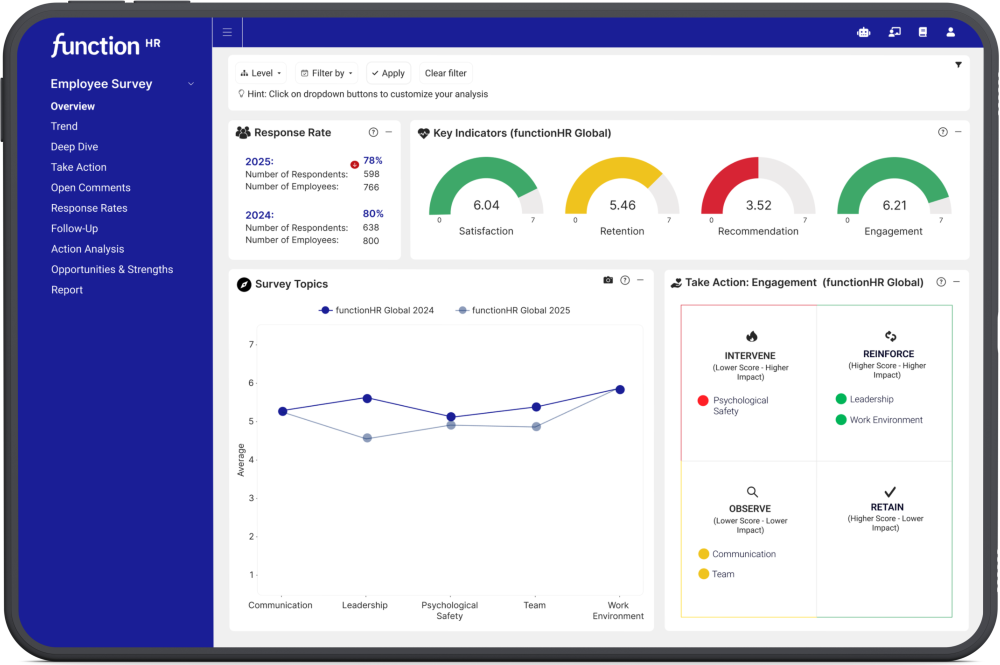
functionHR Dashboard – Employee Survey Evaluation
GDPR-compliant
Setup within days
Real-time analytics
Scientifically validated
Made in Germany
Personal expert support
12 — Frequently Asked Questions

Frequently Asked Questions About Employee Surveys

How often should an employee survey be conducted?

There is no universal recommendation. A proven approach combines a comprehensive annual employee survey as a strategic assessment with pulse surveys every three to six months for operational monitoring. Higher frequencies increase the risk of survey fatigue and response bias.

From what sample size are employee survey results representative?

For company-wide conclusions, a participation rate of 70 percent serves as a benchmark. For group analyses, at least 30 responses should be present to distinguish statistical random variation from genuine differences. Results from units with fewer than 5 responses are not meaningfully interpretable and should not be reported separately.

How is genuine anonymity in an employee survey ensured?

Technically through pseudonymised access, minimum thresholds for displaying results, and the avoidance of person-identifying metadata. Organisationally through a clear works agreement that bindingly governs evaluation rules, and through transparent communication of these rules to the workforce before the survey begins.

How should the works council be involved in an employee survey?

In Germany, the works council has genuine co-determination rights under §87 Para. 1 No. 6 BetrVG. Early involvement is not a risk but a success factor: an informed works council that supports the survey increases the credibility of the instrument and thus significantly raises the participation rate. This principle applies broadly in co-determined workplaces across Europe.

What is the difference between an employee survey and 360-degree feedback?

An employee survey is an organisational diagnostic instrument: it captures satisfaction, engagement, and working conditions of the workforce at group and organisational level. 360-degree feedback is an individual development instrument: it provides individual managers with feedback on their leadership behaviour from multiple perspectives. Both instruments serve different purposes and complement each other in an integrated HR concept.

What should I look for when selecting employee survey software?

Key criteria include: technically implemented anonymisation (not just contractual assurance), scientifically validated questionnaire templates, AI-powered evaluation beyond descriptive statistics, role-specific dashboards, HRIS integration capability, GDPR-compliant data storage within the EU, and scalability for larger workforces. For US-based providers, verify adequate data protection levels following the invalidation of the Privacy Shield in 2020.

Would you like to use our employee survey software for your company?

Book a free demo now and experience how functionHR's employee survey platform works in practice — including AI-powered analytics, role-specific dashboards, and built-in follow-up processes.

Book free demo →

Mask group 3 Employee Survey
Mask group 4 e1683741390842 Employee Survey

With functionHR, we gain deep insights into the work experiences of our employees. The platform enables us to conduct digital surveys among our blue-collar employees as well, where we have achieved very high response rates. The analytics platform allows us to interactively analyze and communicate the results, and derive action plans that are tailored to our needs.

Birk Alwes
Head of HR | HAI Group