360-Degree Feedback: Fundamentals, Methods & Successful Implementation
360-degree feedback is one of the most powerful methods in leadership development, provided it is methodically planned and professionally executed. This guide explains how 360-degree feedback works, what conditions are needed for successful implementation, and how HR teams can design the process in a data-compliant, results-oriented way.
What is 360-Degree Feedback?
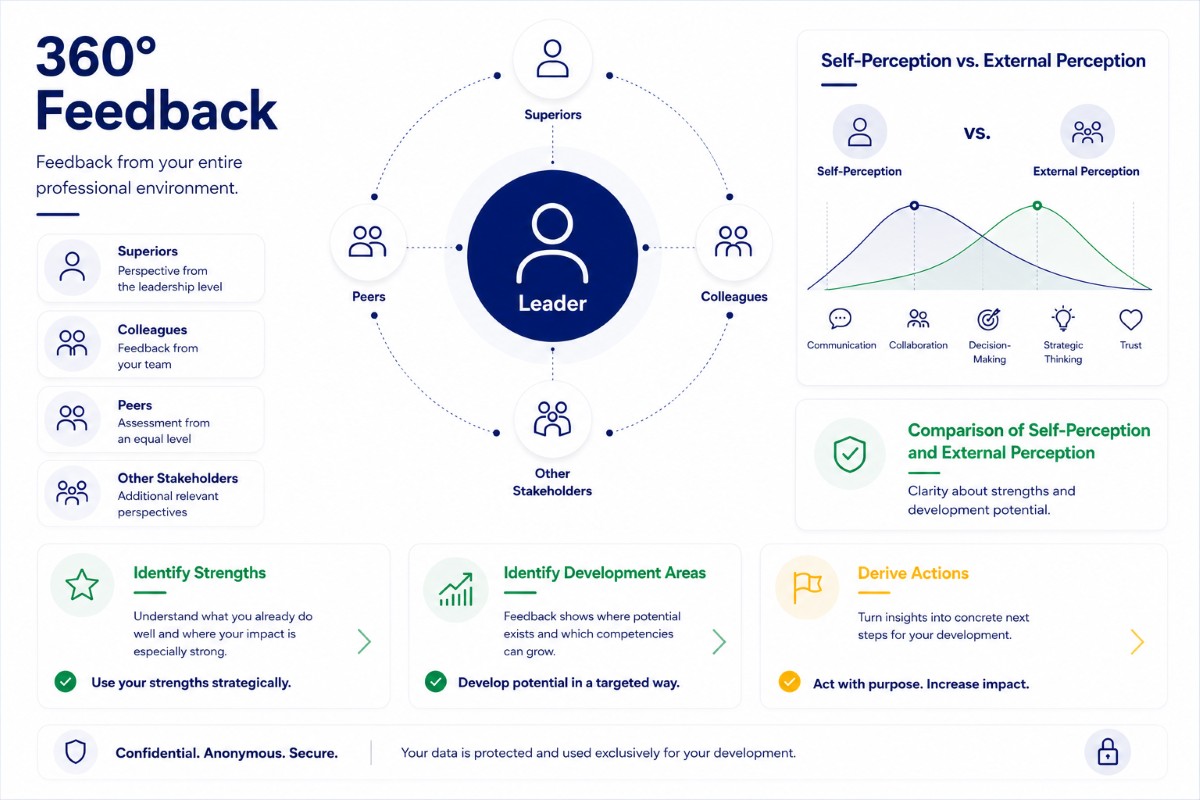
360-degree feedback, also known as multi-rater feedback or multi-source assessment, is a structured feedback process in which an individual receives input from multiple perspectives: direct managers, peers at the same level, direct reports, and optionally a self-assessment. Some variants also include external raters such as clients or project partners.
The core principle: no single viewpoint, neither a manager's nor one's own, is fully objective. Only the interplay of multiple perspectives produces a reliable picture of strengths, development areas, and blind spots. This is precisely what makes the method one of the most valuable tools in modern leadership development.
Which feedback sources are included?
A classic 360-degree process typically draws on the following rater groups:
Distinction: 360-degree feedback vs. traditional performance appraisal
Traditional performance appraisals by line managers are single-perspective instruments, often carrying a strong evaluative component. 360-degree feedback, by contrast, is primarily a development tool: it does not aim at salary decisions or promotion outcomes, but at structured learning from multiple viewpoints. This distinction is critical for participant buy-in, honesty of responses, and ultimately, effectiveness.
When is 360-degree feedback particularly valuable?
- For targeted development of leaders and high-potential employees
- After transitions into new leadership roles (leadership onboarding)
- Within structured talent programmes and leadership tracks
- In preparation for promotions or the next career step
- As a recurring instrument in feedback cultures with high psychological safety
- To support transformation processes requiring new leadership competencies
Self-Perception and Others' Perception: The Heart of 360-Degree Feedback
What makes 360-degree feedback truly valuable is not the volume of data, but the shift in perspective: How do I see myself, and how do others see me? The gap between these two pictures is often more revealing than any single rating in isolation. In psychology, this is called the self-other agreement, and it is precisely this gap that serves as the starting point for genuine development.
What self- and others' perceptions reveal
The self-perception describes how a leader evaluates their own behaviour: their communication style, decisiveness, and approach to conflict. The others' perception is the aggregated view of all rater groups: managers, peers, and direct reports assessing the same behaviours from their respective angles.
Both perspectives are valuable, but for different reasons. Self-perception reveals capacity for reflection and a leader's own understanding of their role. Others' perception shows the actual impact experienced by those around them. Only when compared directly do these views produce a complete, reliable development profile.
The four patterns in self-other comparison
In practice, HR teams encounter four characteristic patterns:
Consistent Strength Profile
Self- and others' perceptions align and are both positive. This leader knows their strengths and applies them consciously. This is a stable foundation that deserves explicit recognition in development conversations.
Blind Spot (Positive)
The leader rates themselves lower than others perceive them. Unrecognised strengths often occur where certain behaviours are so natural they are not seen as remarkable. For the leader, this is a motivating and energising result.
Overestimation
Self-assessment is notably more positive than others' perceptions. This is the most sensitive pattern and also the most development-relevant. Professional support is especially important here to prevent defensive reactions.
Underestimation
The leader judges themselves more harshly than their raters do. This pattern is common among experienced professionals who hold themselves to high standards. It signals untapped confidence and underused capability.
Why discrepancies are not a sign of failure
A common misconception: large gaps between self- and others' perception are experienced by feedback recipients as negative evaluations. The opposite is true. Someone showing no discrepancy either has an exceptionally high level of self-awareness, or the process is not being taken seriously by raters.
From an HR perspective, significant discrepancies are evidence that the instrument is working. The task is to translate these insights into productive development conversations, without blame, but with a clear commitment to growth.
Practical implications for HR
- Feedback reports should always display self- and others' perceptions side by side visually, not just as numerical values
- Debrief conversations ideally start with the leader's own self-assessment before showing others' perceptions
- Strong overestimations should never be delivered without professional support. A coach or HR business partner is essential
- Underestimations are an opportunity for strengths-based conversations that build self-efficacy
- Multiple rater groups should be reported separately, because the perspective of direct reports systematically differs from that of peers
Questionnaire Quality: Why the Instrument Determines the Value
A 360-degree process is only as good as the questionnaire it is built on. This may sound obvious, but in practice, it is one of the most underestimated variables. Not every list of leadership questions constitutes a valid measurement instrument. And the consequences of a poor questionnaire are serious: unreliable results, development measures targeting the wrong issues, and in the worst case, lasting damage to trust in the entire process.
The three quality criteria of a valid questionnaire
Competency models as the foundation: leadership is context-specific
A common mistake in questionnaire design: generic leadership competencies are surveyed that apply equally to every leader. In reality, effective leadership is highly context-dependent. A leader in operations faces different demands than one in sales or in an agile product organisation.
Proven competency models therefore distinguish by leadership context and level. Typical dimensions include task-oriented competencies (e.g. goal-setting, planning, accountability), relationship-oriented competencies (e.g. giving feedback, building trust, conflict management), and change-oriented competencies (e.g. openness to innovation, tolerance of ambiguity, strategic thinking). Which dimensions matter for a specific leadership role should be derived from the organisation's strategy and leadership principles, not from a generic off-the-shelf catalogue.
What distinguishes a good questionnaire from a poor one
Good Questionnaire
- Measures observable behaviour, not abstract traits
- Based on validated competency models with empirical foundations
- Contains 25–40 items, focused rather than exhaustive
- Clear and unambiguous rating scale, e.g. a five-point frequency or agreement scale with labelled points
- Includes open questions for qualitative feedback
- Tailored to leadership level and context
Poor Questionnaire
- Asks about personality traits rather than behaviours
- Too long: more than 60 items lead to survey fatigue and response bias
- Not context-specific, same items used across all levels and functions
- Ambiguous or inconsistently interpreted scale
- No connection to the organisation's leadership principles
- Not empirically validated, based on subjective assumptions
Standardised or customised: what works when?
Many software providers offer ready-to-use question catalogues. This has practical advantages, especially when starting out or running small projects. The downside: standardised catalogues cannot reflect what "good leadership" means within a specific organisation.
The pragmatic middle ground that works well in practice: a scientifically validated core catalogue forms the foundation, supplemented by organisation-specific questions reflecting the company's leadership principles, values, or strategic priorities. This produces an instrument that is both comparable and contextually relevant.
From Feedback to Behaviour Change: Why the Report is Only the Beginning
A well-executed 360-degree feedback process does not end with the feedback report. It begins there. The real question is: what happens after the leader has seen their results? In practice, this is the stage most frequently neglected: the translation of feedback into concrete, lasting behaviour change. And without it, the majority of the investment evaporates.
Why feedback alone is not enough
Feedback creates awareness, but awareness alone does not change behaviour. Between the moment a leader reads their feedback and a sustained behaviour change lie several psychological steps: the person must accept the feedback, recognise the need to change as personally relevant, believe in their capacity to change, and finally find the motivation to act differently in daily situations. A meta-analysis of 24 longitudinal studies shows that leaders are most likely to improve when they accept the feedback, recognise a need to change, and set concrete goals (Smither, London & Reilly, Personnel Psychology, 2005).
There is also a frequently underestimated factor: the social environment. Even when a leader changes their behaviour, colleagues and team members must perceive and positively reinforce that change, otherwise the person reverts to old patterns. Change research and leadership development refer to this as the "acceptance of changed behaviour by the environment" as the decisive final barrier (cf. Bracken & Rose, Journal of Business and Psychology, 2011).
The five stages of effective feedback follow-up
Common mistakes in follow-up
- Sending results without support, because "self-study" is not enough
- Tackling too many development areas simultaneously
- No follow-up appointment agreed, so no accountability
- Development goals formulated in abstract rather than behaviour-based terms
- Managers not involved, development remains isolated
- No second feedback cycle, progress remains invisible
When does coaching add the most value as a support measure?
Coaching based on 360-degree results is particularly effective when results show significant discrepancies between self- and others' perceptions, when leaders in high-complexity or high-visibility roles are being developed, or when concrete behaviour changes need to be demonstrated within a defined timeframe, for example, within a talent programme or succession planning process.
Importantly, coaching and 360-degree feedback are not competing approaches but a highly effective combination. Feedback provides the data-driven diagnosis; coaching provides the individual support for implementation. A study of more than 1,300 leaders shows that those who worked through their 360-degree results with a coach set more specific goals, asked for improvement ideas more often, and improved more in subsequent ratings than leaders without a coach (Smither et al., Personnel Psychology, 2003).
Smither et al., Personnel Psychology, 2003
Harvard Business Review, 2017
Harvard Business Review, 2017
360-Degree Feedback that goes beyond the report
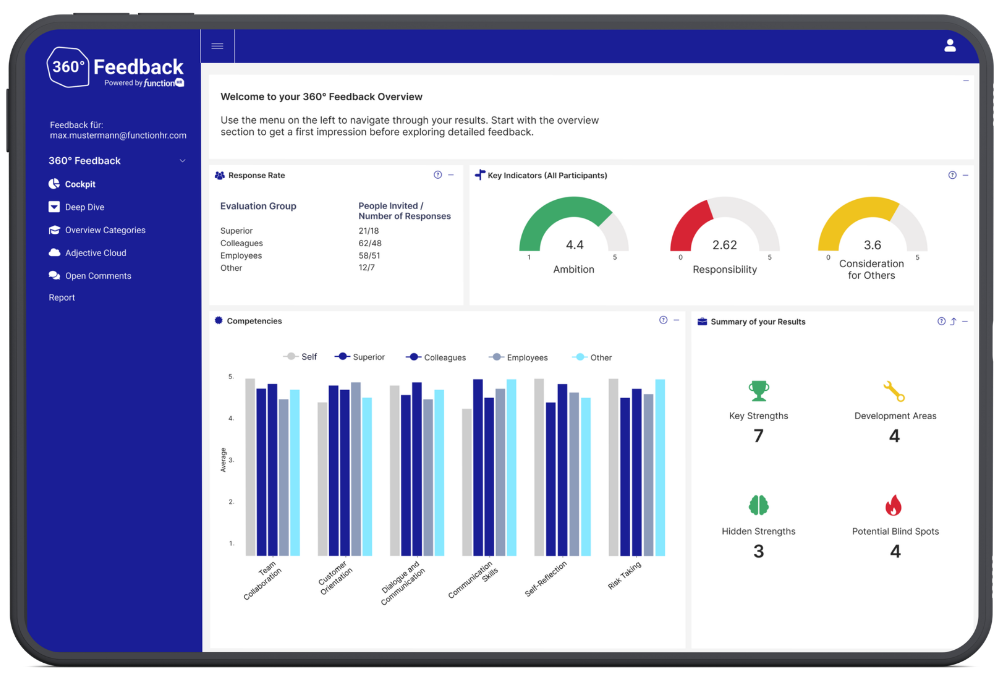
functionHR supports the entire cycle: from the survey through automated feedback reports to structured tracking of development goals.
What 360-Degree Feedback Delivers for HR and Organisations
360-degree feedback delivers its full value when three conditions are met: a validated question set, an organisational basis of trust, and professional support for feedback recipients. When these are in place, the instrument addresses central challenges of modern people management.
For feedback recipients
- A clear, multi-dimensional picture of their own impact on others
- Uncovering blind spots that remain invisible in day-to-day work
- Concrete development impulses rather than generic performance feedback
- Strengthened self-awareness through self-other comparison
- Higher motivation through structured recognition of strengths
For HR and People Leads
- Data-driven foundation for talent conversations, succession planning, and development initiatives
- Scalable execution for many leaders simultaneously, without manual coordination
- Comparability across teams, levels, and locations
- Early identification of leadership risks and development needs at team level
- Measurable leadership development across feedback cycles
For the organisation
- Stronger feedback culture through regular, structured feedback processes
- Reduction of leadership failures through increased self-reflection at all levels
- Better employee retention through perceived investment in leadership development
- Alignment with competency models and strategic HR goals
Recognising Strengths
Multi-perspective feedback surfaces strengths that feel routine in day-to-day work. For leaders, this is often a genuinely surprising and motivating experience for leaders. The explicit recognition of strengths by peers and direct reports has demonstrably positive effects on engagement and self-efficacy.
Uncovering Blind Spots
Blind spots arise when one's own behaviour is consistently perceived by others in a different way than by oneself. The feedback makes this discrepancy visible, without accusation and based on structured data. This is the prerequisite for genuine behaviour change.
Implement 360-Degree Feedback Professionally
Discover in a personal demo how functionHR maps your entire 360-degree process digitally, from questionnaire configuration to automated results distribution.
When and for Whom is 360-Degree Feedback the Right Tool?
360-degree feedback is not a universal instrument. It delivers its greatest value in defined contexts and for specific target groups. HR teams should intentionally align its deployment with strategic goals and keep in mind: the process creates expectations among participants. If these are not met, acceptance suffers long-term.
Typical use cases at a glance
Leadership Development
The classic and most common application. Leaders at all levels, from team leads to senior executives, receive structured feedback on competencies such as communication, decision quality, employee development, and strategic thinking. Serves as the basis for individual development plans and coaching engagements.
Talent Management & High-Potential Programmes
360-degree feedback complements traditional potential assessments with an external perspective. Talented individuals with strong overestimation or unrecognised strengths become visible early. Particularly valuable in structured talent reviews and succession planning for key roles.
Onboarding into Leadership
New leaders, whether promoted internally or hired externally, benefit from an early-cycle feedback after 6–9 months. It helps identify initial blind spots before they become entrenched, and signals to the team: development is taken seriously here.
Cross-Functional Collaboration
In matrix organisations and cross-functional projects, traditional hierarchical feedback quickly becomes incomplete. Multi-rater feedback makes peer perspectives systematically actionable. This is a decisive advantage when assessing collaboration competencies.
Leadership Development Programmes
In internal or external development programmes, the feedback frequently serves as the starting point. Participants receive a clear baseline at the beginning of a programme, and a measure of development progress at the end. This makes training investments demonstrably worthwhile.
Culture Change & Transformation
When organisations introduce new leadership principles, such as greater empowerment, more agile leadership, or stronger customer orientation, 360-degree feedback provides a scalable method to measure and actively steer the development of leadership culture.
Who should not be surveyed with this method?
360-degree feedback is suited to leaders and individuals with clearly defined peer networks. For employees without leadership responsibility and without regular cross-functional collaboration, the multi-perspective advantage largely disappears. Here, other feedback formats such as regular 1:1s, team retrospectives, or classic employee surveys are more effective than a multi-rater approach.
360-Degree Feedback in 6 Steps: A Practical Guide
Careful process planning is the single most important success factor for 360-degree feedback. Mistakes in preparation, such as unclear goals, poorly communicated confidentiality, or absent follow-up, leave lasting marks on participant acceptance. The following step-by-step structure has proved effective in practice.
Common pitfalls and how to avoid them
- Lack of goal clarity creates distrust among participants
- Rater groups that are too small compromise confidentiality
- Linking results to compensation destroys feedback honesty
- No follow-up: results have no impact
- Overly long questionnaires dramatically reduce response rates
- Feedback reports without actionable recommendations overwhelm recipients
Confidentiality and Data Privacy: The Foundation of Every 360-Degree Process
No other factor determines the success or failure of 360-degree feedback as fundamentally as the question of confidentiality. When raters fear that their responses can be traced back to them, they give socially desirable rather than honest feedback. The result: data without meaning.
In addition to confidentiality, organisations deploying 360-degree feedback process personal performance and behavioural data, a highly sensitive data segment that requires both technical and organisational protection measures. Depending on the jurisdiction, different data privacy regulations apply; in the EU, GDPR sets the standard, while other regions have their own frameworks (e.g. CCPA in California, PIPEDA in Canada, or PDPA in various Asian markets). HR teams should verify the applicable requirements for their specific context.
Ensuring confidentiality technically
- Minimum rater count per group: Results from rater groups with fewer than 3 participants are not reported individually, only as an aggregated value.
- Pseudonymised survey access: Raters receive individual access codes that provide no traceable link to their identity.
- Separate data storage: Raw data at rater level is not stored in conjunction with the recipient's report.
- Open comment moderation: For open-text responses, a review stage or automated anonymisation is recommended to prevent stylistic identification.
- No individual manager reporting: The manager rating is only reported where it carries no risk of identifying a specific individual.
GDPR-compliant implementation: checklist for HR
- Data Processing Agreement (DPA) signed with the software provider
- Server location within the EU, no data transfers to third countries
- Legal basis for data processing documented (typically legitimate interest or works council agreement)
- Works council or employee representative body involved at an early stage (where applicable)
- Participants informed in advance about purpose, scope, and data privacy
- Retention and deletion schedules defined for survey data
- Access rights clearly defined: who can see which results?
- No automated decision-making based on 360-degree data without human review
Works council and co-determination rights
In Germany, the introduction of 360-degree feedback typically falls under co-determination rights pursuant to § 87 (1) No. 6 of the Works Constitution Act (BetrVG), as it may constitute a technical system for monitoring employee behaviour or performance. HR should involve the works council at an early stage, not only for legal reasons, but because this involvement significantly increases acceptance across the workforce.
In other countries and jurisdictions, equivalent employee representation frameworks may apply (e.g. European Works Councils, trade union consultation rights, or specific national legislation). HR teams operating across multiple markets should verify the relevant co-determination or consultation requirements in each location before rollout.
The functionHR platform is GDPR-compliant and operates all data exclusively on servers located in Germany. functionHR works with Intersoft Consulting Services AG as its external data protection officer. The platform is certified to ISO/IEC 27001:2022, the current international standard for information security management systems. Defined deletion processes and regular privacy reviews are integral parts of the platform.
360-Degree Feedback Compared with Other Feedback Formats
360-degree feedback is one of several HR instruments for capturing performance, potential, and development needs. Which format is right depends on the objective, the target group, and the organisational context. An overview of the key alternatives and how they differ from the 360-degree approach.
Overview: Which instrument for which purpose?
Multi-perspective view, ideal for leadership development, high validity through aggregation.
Requires investment in preparation, depends on a trust foundation, not suitable for all employee groups.
Measures mood, engagement, and retention at organisational level; scalable for all employees.
No individual leadership feedback; aggregated view, no individual profile.
Individual, conversational, flexibly applicable.
Single-perspective (one viewpoint only), dependent on conversation quality; no systematically comparable data.
Clearly structured, documented, linked to compensation.
Strong tendency toward social desirability; evaluative rather than developmental framing; frequent halo effects.
Continuous sentiment tracking, fast response capability, high participation through short formats.
No feedback on individual leaders; snapshot without in-depth analysis.
Very high candidate acceptance and face validity; direct behavioural observation; ideal for selection decisions.
Resource-intensive and costly; not scalable for ongoing development; no everyday-context perspective.
When to combine 360-degree feedback with other methods?
The most effective HR systems combine multiple instruments thoughtfully: 360-degree feedback delivers the individual development profile at leadership level, while employee surveys measure organisational climate and pulse surveys provide continuous sentiment barometers. This combination enables HR teams to intervene precisely at both individual and team level.
Recommended Combination for Leadership Development
360-degree feedback (1–2× per year) + pulse survey at team level (quarterly) + structured development conversation after each 360-degree cycle. This generates continuous data at individual and team level with clear development impulses.
Recommended Combination for Culture Measurement
Employee survey (1× per year, all employees) + 360-degree feedback for leaders (same cycle) + driver analysis linking both datasets. Result: understanding which leadership competencies have the strongest impact on engagement and retention.
From questionnaire to automated results distribution: everything in one platform
functionHR maps the entire 360-degree process digitally: scientifically validated question catalogue, flexibly configurable rater groups, automated invitation and reminder delivery, and interactive individual and group reports with AI-assisted comment analysis.
Clients such as Lufthansa AG and HDI use functionHR for scalable leadership development, GDPR-compliant, with servers located in Germany and dedicated expert support.
Request a demo →